
Two Truths & a Lie
On releasing a monster...

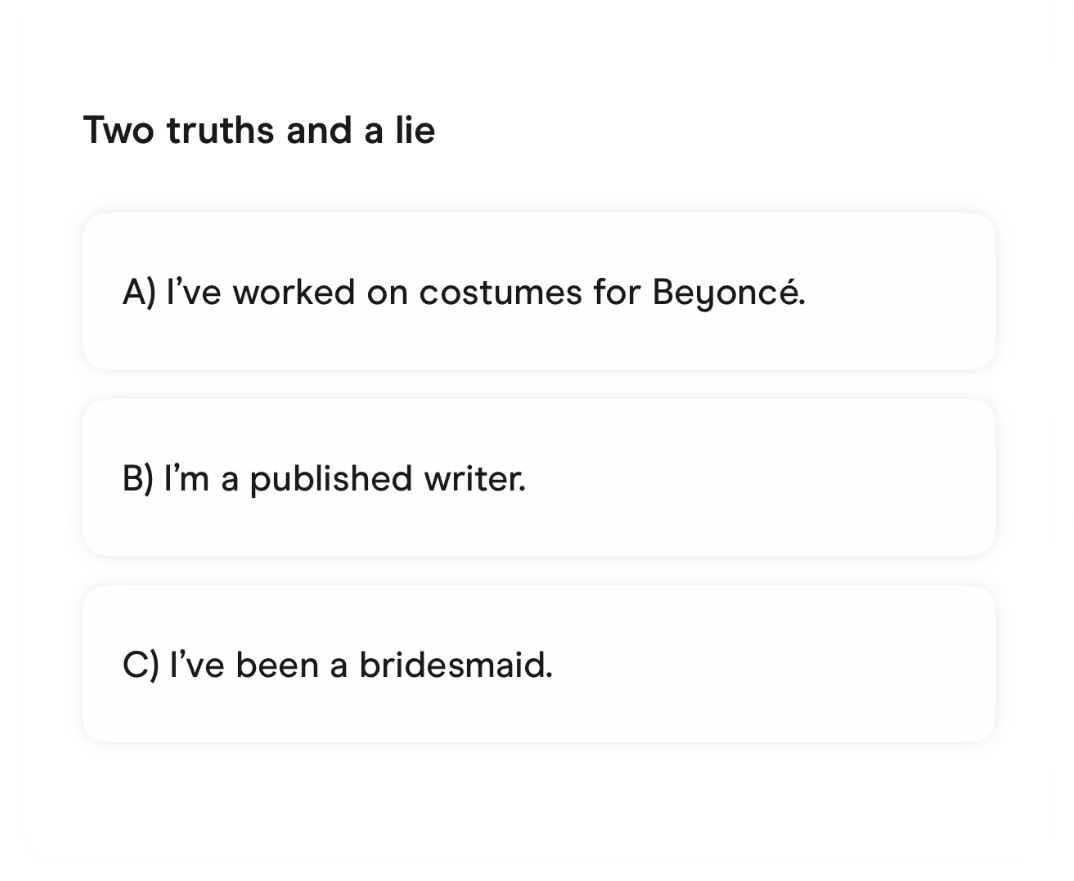
Two truths and a lie used to be a prompt on my Hinge profile.
‘B’ was always the lie: I’m a published writer.
Until today…
This is my first-ever publication. A lyric essay called Monster Theory, published by Blood+Honey Literary Magazine.
I didn’t really know what a lyric essay was before I wrote it, which feels—now—fitting. It’s a form that lets you think on the page instead of proving a point. To worry at a thought the way the tongue worries a loose tooth.
I wrote it after coming home from a date that was, by all visible measures, completely fine. Objectively nice. We’d been texting for weeks, everything looked good on paper, and then we met—and nothing happened.
And it wasn’t heartbreak. It wasn’t anger. It wasn’t even disappointment.
It was the averageness of it.
The unspectacularness.
No sadness that it didn’t work out. No rage that he was a dick. No gooey warmth when it goes really well. Not even that familiar, faintly embarrassing delusion that I liked him more than he liked me.
Just… nothing.
And that nothing unsettled me more than any dramatic ending ever has.
I think about men a lot (occupational hazard). Not abstractly, not ideologically, but physically. I think about them with the particular doubleness of someone who is one himself: close enough to recognise the mechanisms, distant enough to still be undone by them. The stubborn, two-plank certainty of shoulders. The way a body seems to arrive in a room before intention does.
I notice the involuntary reveals: tendons rising like cables when hands flex; the brief, unconscious tongue-dart when concentration tightens; the belt-tugs, the reflexive hand to the back of the neck, the way men square themselves to no one in particular, as if bracing for an impact that never comes. When desire moves between men, it inevitably returns to the body. Physicality lingers where language fails; it outlasts the date, the conversation, the polite goodbye. It follows me home.
After the date, this feeling hadn’t vanished.
It had simply slipped its leash.
And that made me panic a bit. Because if this is what dating looks like now—efficient, polite, emotionally flat—what does wanting even turn into?
So I opened my laptop and started writing without thinking anyone would ever read it. What came out was this list. About men, desire, envy, fantasy, and the private mythologies we erect to make longing feel legible.
Monster Theory is about what happens when want hangs around too long—and starts to look back at you. If you’ve ever left a date feeling strangely empty, or wondered whether love is broken, or just misnamed, this five-minute read is for you.
And for the ten-year-old version of me who once typed “Chapter 1” and stared at a blinking cursor, unsure if this would ever count as anything: today, it does.
Thank you for reading to the end.
Your attention isn’t automatic, and I don’t take it lightly. If something about Monster Theory stayed with you — or didn’t — you’re welcome to reply and tell me. I like hearing how readers move through the work.
If you’d like to share this with someone else, I’m grateful. If not, that’s fine too. However you engage, thanks for being here.
— G