
Saint Hilary
In Praise of an Accidental Icon

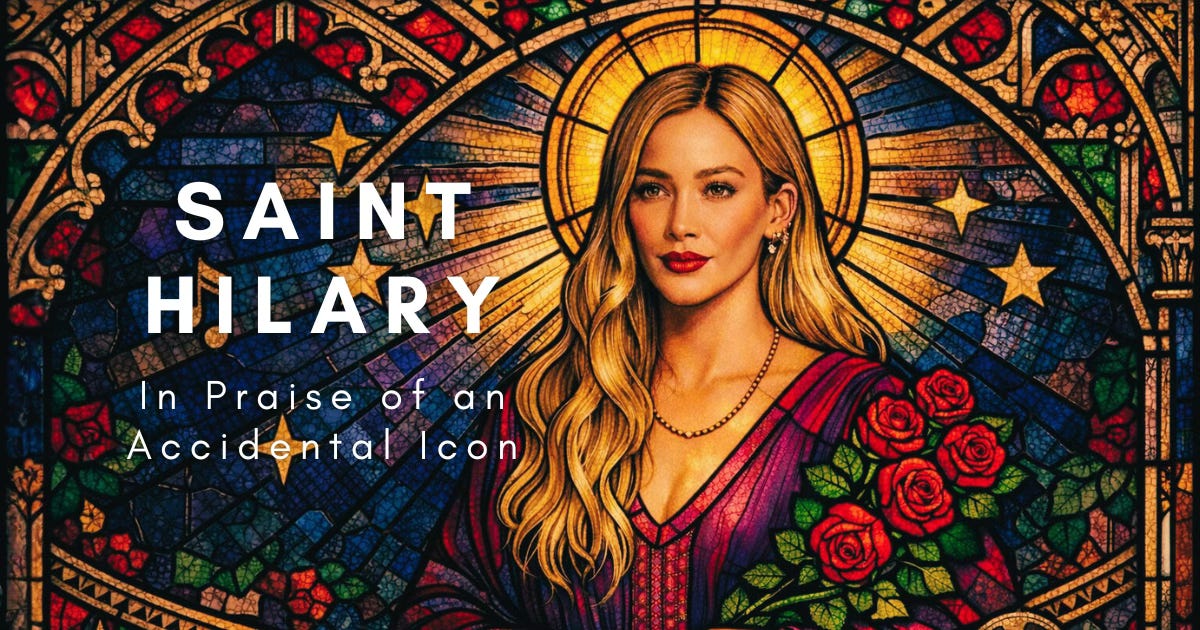
There was no rupture in the sky. No flare, no burning bush, no sense that anything had tilted on its axis. It arrived the way most revelations do now — as a headline in the endless, flattened scroll of Variety, identical to box-office projections and contractual speculation. Revelation, in industry font. A life-altering sentence wearing the same typography as a streaming deal.
Hilary Duff, at Vogue World, had teased new music. Days later, at the Academy Museum Gala—wearing a purple Alberta Ferretti gown with the composure of a woman who had survived being a girl in public—she said her music was being made specifically for her gay fans. She did not buffer the claim with allyship language or careful hedging. She said it plainly: “You know it’s all for them. It’s just to impress them.”
It was tossed off, almost careless. Which is to say: it sounded true.
I read it alone at my kitchen table in the countryside, late October light thinning before five. The kettle had just clicked off. Wet leaves were pressed against the window like something trying to get back in. I was thirty-two — old enough to recognise nostalgia when it arrived. Whatever part of me might once have mistaken that sentence for deliverance had, by then, learned to function without ever being addressed directly.
And still, something unsettled me.
Recognition rarely arrives on time. It circles. It waits until you’ve constructed a workable life and then returns to name what was already happening in private.
Twenty years earlier, in the long narrow bedroom of my childhood home, I consumed Duff’s films and albums with an intensity outsized for a twelve-year-old — door closed, headphones plugged in, watching and listening as if it mattered. The television screen cast the room in a bluish, almost ecclesiastical glow. I was safe. I knew I was safe. But I kept the volume low anyway.
I didn’t hide my love of her. My family never interrogated why my taste angled so decisively toward her at twelve, that precarious hinge between childhood and something else. They could have made it into a joke, or a warning, or a diagnosis. Instead, they indulged it. They bought the CDs. They tolerated the rewatches. They allowed it to be ordinary. And I was grateful in the way children are grateful for permissions that feel larger than they look.
Inside, my fandom was harmless, almost wholesome. Outside, I sensed — without having language for it — that the enthusiasm would require management. Beneath the clean, aspirational girlhood she projected, something in me was already negotiating how much of itself it could afford to show. I knew instinctively that I would not be able to love her as loudly in the world as I did in my room.
I had only the vaguest outline of who I was then, mostly because other people seemed to know before I did. Some of us do not have the luxury of ambiguity. It announces itself in the flick of the wrist, the roll of the S’s. I understood, dimly, that I was being read.
What I knew was that her material mattered. Not because it was teaching me about love — it wasn’t. It was about how to divide the self without breaking it.
Later, I would test that lesson more literally than I care to admit. But at twelve, I only felt its usefulness. That is the comfort of media at any age: a relief of knowing that if you studied closely enough, you could learn how to pass.
The question of whether I liked Hilary Duff because I was gay, or whether I was gay because I liked Hilary Duff is the sort of circular logic that keeps you awake and writing essays at thirty-two. It suggests origin where there is only atmosphere. It asks for causation when what you’re really dealing with is conditions.
The truth is less cinematic. Sexual identity and aesthetic preference do not manufacture one another. They lean. They echo. They inform each other with the inevitability of tides pulling against a shore that was already shaped to receive them.
I can locate her arrival precisely. It was 2003. The Lizzie McGuire Movie was in cinemas. I spent Christmas money on Metamorphosis. “Come Clean” was climbing the charts, projecting a cooler, frostier adolescence I hoped to inhabit.
Six months later, in my first year of secondary school, my dad came home holding a burned DVD in a slim plastic sleeve, as though he’d procured something faintly illicit. The disc was labelled in black marker: A Cinderella Story. It had not yet reached our one-screen cinema. American films arrived late, rationed. You waited for them. You relied on intermediaries. I say this fondly: a copied disc was a small, delicious rebellion.
The disc whirred uncertainly in the player. The screen flickered before stabilising. Bootleg technology came with its own anxiety—the possibility that the image might collapse, that the miracle would fail. When it didn’t, when the film steadied and began in earnest, I felt something that far exceeded the object itself.
It wasn’t pleasure. It was recognition.
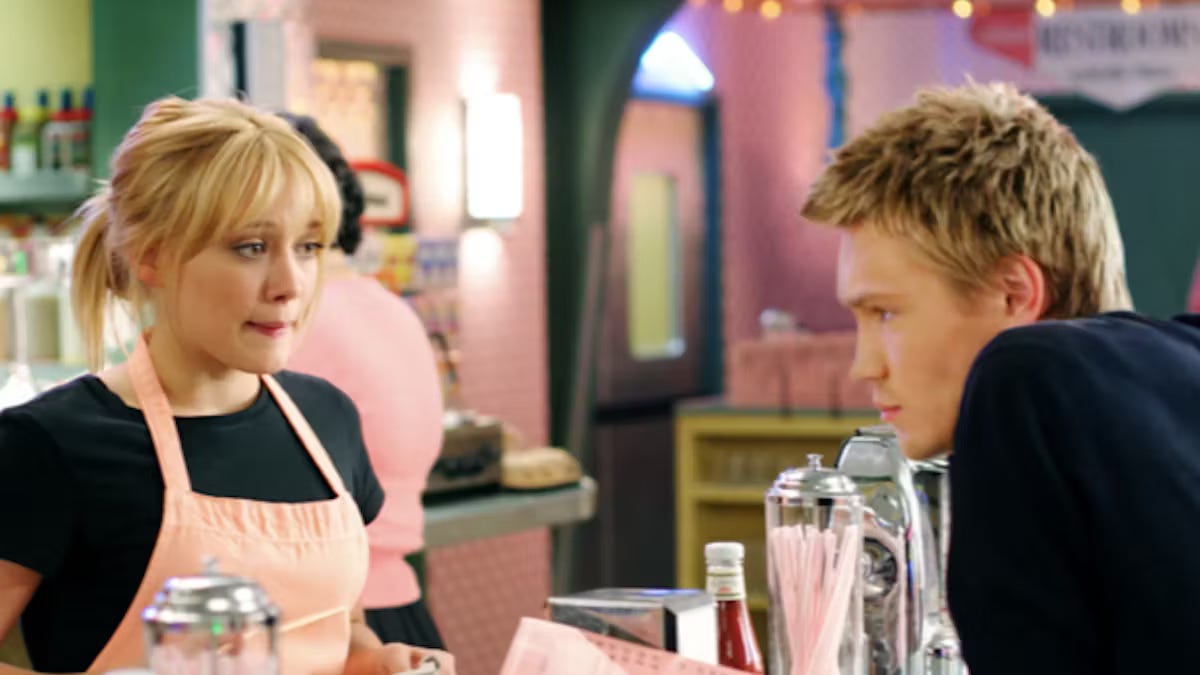
The plot of A Cinderella Story is obedient in the way studio fairy tales of the early 2000s so often were: emotionally legible, morally symmetrical, engineered to deliver self-belief in ninety minutes and a closing pop song. Duff plays Sam Montgomery — orphaned, industrious, trapped under the tyranny of a stepmother played hilariously by Jennifer Coolidge. By day, Sam works in a diner and aces her AP classes. By night, she conducts an anonymous online romance with a boy she believes understands her. He turns out to be the most popular boy at school. There is a dance. There is a deadline. There is a midnight.
What lingers is not the fairy-tale machinery but the logistics of how she survives inside it. Sam does not divide herself because she is duplicitous; she divides herself because the world around her requires adjustment. Daylight demands legibility: good grades, good posture, economic usefulness. Online, she becomes distilled into language — quick, articulate, bodiless. Her intelligence circulates without the complication of being seen. She is most compelling when she is least physically present.
There is nothing villainous in this. It is simply practical.
At twelve, no one needed to explain this to me. The division was not artful; it was didactic. Here is how you preserve something interior while navigating a room that may not know what to do with it. Here is how you remain intact by offering only portions.
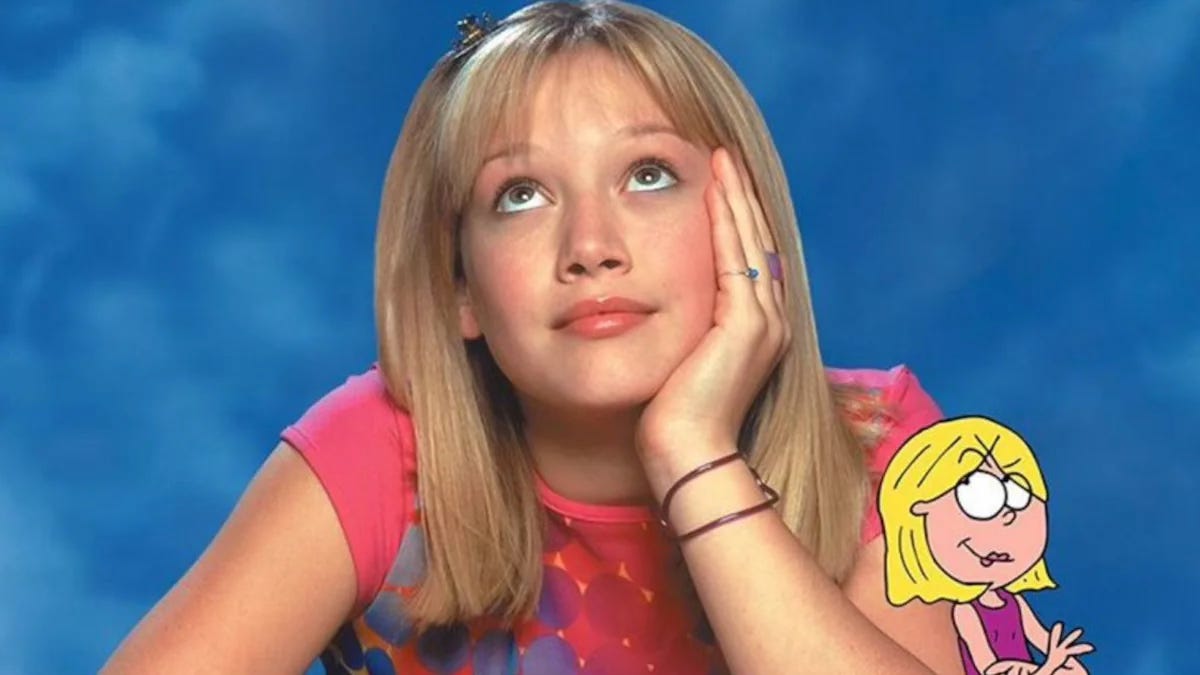
The same mechanics animated Lizzie McGuire, where the most truthful version of the protagonist existed in cartoon form—limbs elastic, mouth stretching beyond anatomical plausibility, panic operatic and therefore excusable. The live-action body remained symmetrical and embarrassed; feeling was permissible so long as it was stylised. The body could remain composed while the animated double convulsed on its behalf.
It is difficult, looking back, not to recognise how thoroughly I internalised that structure. Not the romance. The idea that the truest self might need intervention before it could be tolerated.
At fourteen, I attempted my own version.
Not gallantly. Not even particularly imaginatively. I acquired the phone number of a boy— seventeen to my newly turned fourteen, which at the time was the distance between mortal and myth — and began texting him under a false name. I framed it, to myself, as curiosity. An experiment in whether attraction could be encouraged to grow if the inconvenient fact of my body were removed from the introduction.
The messages were laboured over. Drafted, revised, stripped of anything that might betray too much eagerness. I believed — with a kind of solemn optimism — that if I arranged the sentences correctly, a genuine friendship might reorganise itself around them. That anonymity was not deception so much as sequencing: intimacy first, disclosure later, acceptance made inevitable by familiarity.
His replies were brief. Guarded. “Who is this?”
After I suggested we get to know each other before I revealed myself, he responded: “I don’t trust easily.”
The line unsettled me in ways I could not then articulate. It punctured the premise that distance was automatically safe. Even at seventeen, he had already learned to be cautious. I was not the first to imagine proximity without exposure.
I did not confess immediately. I did not stop immediately. But the storyline I had been rehearsing — that abstraction could secure affection — began to thin. I didn’t yet understand that this had very little to do with romance and everything to do with trying to be wanted without being fully seen. At fourteen though, that logic arrived packaged as narrative — buoyed by a Duff soundtrack promising transformation without collision.
Her music moved in the same register. Metamorphosis flooded the room with engineered optimism and mall acoustics, critics dismissing it as lightweight without recognising how functional that lightness could be. “Come Clean” became devotional not because the metaphor was sophisticated, but because it made exposure feel rhythmic rather than catastrophic. “I’m shedding every colour…” suggests transformation as seasonal and atmospheric, something that happens around you rather than because of you. The rain in the chorus softens the edges of the world; it does not interrogate it. Exposure, scored gently. Change, occurring on cue.
The sophomore effort — Hilary Duff — was the first crack in its shell, but the underlying promise stayed steady. “Fly” encourages you to “open up the part of you that wants to hide away,” yet leaves mercifully vague what might spill out if you did. Two decades later, it’s circulating on TikTok as a kind of elegy for lost optimism, a relic repurposed for people now old enough to know what it costs to “fly.”
On Dignity, the sound had hardened. The beats were colder, the synths cleaner, her voice sitting lower in the mix, less breathless than before. Fans like to compare it to Britney’s Blackout, and the sleekness makes the comparison easy, but what stayed with me wasn’t the edginess. It was the restraint. She didn’t set fire to her earlier self. She carried her forward.
Even on Breathe In. Breathe Out, her most dance-pop assured, self-belief is styled as composure rather than revolt. Across the catalogue, intensity moves freely but never shatters the frame. You are invited to feel expansively while remaining assembled. For anyone already negotiating which parts of themselves were admissible, that steadiness was a relief.
It would be tempting to credit these films and songs with teaching me how to compartmentalise. Influence, though, rarely invents; it affirms. The impulse was already there, half-formed. The music and movies just illuminated it. What I did not yet understand was that strategies designed for adolescence have a way of hardening. That what begins as improvisation can solidify into habit. That approaching intimacy abstractly can become less a phase than a pattern.
If A Cinderella Story suggests that anonymity might polish desire into something purer, The Perfect Man presses harder on the same idea and exposes the pressure points. Fabrication is reframed as devotion. A daughter invents a secret admirer to restore her mother’s faith in love, writing tenderness under a borrowed name. The lie is presented as temporary — protective, even generous — a bridge built to carry someone safely toward the truth.
The first time I watched it, I absorbed the sentimentality. Years later, the mechanism was harder to ignore.
The boy was, within the tight ecosystem of adolescence, extraordinary. Crushes at that age have very little to do with who someone is and everything to do with what you can project onto them. You construct a cathedral out of fragments — stories passed down, photos on MySpace, the memory of how he once walked through a corridor that no longer belonged to him. By the time I texted him, he had already left school. That distance only improved the illusion. Three years older. Edge of seventeen. To me, he wasn’t simply attractive; he appeared complete. As though whatever process was still scrambling me had already resolved itself in him.
I had grown out of distant celebrity fixations by then — the safe absurdities of pop stars and actors whose images could be adored without consequence. This was different. This was proximity. Each time the phone vibrated, something inside me braced.
So I did what Sam Montgomery did. I removed myself from the frame.
I rewrote sentences until they sounded effortless rather than hungry. I deleted anything that might tether the message too clearly to the body typing it. I convinced myself that if the words were shaped carefully enough, they could stand in for me — that interest might attach itself to tone, to wit, to whatever version of me existed without posture or voice.
It did not occur to me, at least not fully, that I was asking to be liked while withholding the fact of who was asking.
The exchange stretched over days, maybe weeks. Shame has a way of compressing time. His responses were brief. Polite. Guarded. When he wrote, “I don’t trust easily,” I read it not as a boundary but as a problem to solve. Something in me believed that patience and good writing could unlock him.
The dissonance grew physical. To be recognisable in tone but not in identity required constant adjustment. I had to remember which version of myself was speaking. I wanted him to want me. I also wanted insulation from the possibility of being the one who wanted more. Those desires began pulling against each other. What I had framed as ingenuity started to feel like a narrowing corridor.
Eventually the strain became unsustainable. Deception did not suit me—not morally, not constitutionally. The only satisfying outcome required disclosure. Disclosure promised humiliation. I had designed a situation in which the exit and the collapse were the same door.
When I finally confessed, I did what I always did when I needed to justify myself: I wrote. The message was long and ornate — part apology, part manifesto. I explained. I contextualised. I tried to transform what I had done into something narratively coherent, if not forgivable.
The reaction was swift and entirely predictable. Word spread. Laughter followed. The grand construction I had assembled disintegrated; the cathedral ground to dust.
Adolescent humiliation has a way of resurfacing long after everyone else has forgotten it. For a long time after the fact, the memory glowed faintly but persistently, a private indictment I carried like a stone in my pocket. I told myself it had made me more restrained. More measured. I learned to funnel feeling into writing and distribute it sparingly elsewhere. I called that maturity.
It was, more accurately, caution.
Adulthood complicated the memory further. When I entered the world of gay dating — first cautiously, then confidently — the mechanics of anonymity were no longer adolescent experiments but ambient reality. Blank profiles. Pictures cropped at the jaw. Names withheld. Ages adjusted. Needs stated boldly and biographies kept deliberately vague. On apps like Grindr, intimacy often precedes identity. You exchange photographs before surnames, vulnerability before verification. Deception is not always malicious; sometimes it is defensive, sometimes aspirational, sometimes simply habitual. But it is common.
I say this without indictment. I have been both the one misled and the one withholding. It is a role I stepped into with unsettling ease: reveal just enough, secure interest first, disclose later if necessary. What I had once framed as teenage misjudgement revealed itself as an early draft of a pattern that the adult world not only permitted but, at times, rewarded.
It is intoxicating. It is also unstable.
When sobriety arrived at twenty-nine, it rearranged the story. Stripped of the self-pitying glow I’d given it, the episode looked different. It was no longer something that had happened to me. It was something I had done. I had treated trust as an obstacle rather than a gift. For years, I had described it as a teenage catastrophe. Under steadier light, it appeared less catastrophic than instructive. I had been experimenting with a way of moving through the world — edging toward intimacy sideways, hoping to secure attachment before disclosure.
That recognition did not soften the memory. It clarified it.
And clarity is not warm. It does not comfort. It simply removes the fog.
This is where Hilary Duff returns — not as culprit, not as catalyst, but as mirror. It would be indulgent to claim her films taught me to deceive. They did something subtler: they made mediation look survivable. They offered templates in which the self could be partitioned: the animated double absorbing intensity, the anonymous correspondence proving worth before embodiment, the invented admirer standing in for courage.
In the absence of open scripts for queer adolescence, I borrowed what was available. I did not have language for what I wanted, only strategies for delaying exposure. Distance seemed liveable. What I mistook for romance was, more often than not, fluency in postponement.
To call Hilary Duff an icon of queer adolescence risks overstating both intention and effect. Icons imply design. The early 2000s operated less by design than by omission.
Queer characters existed, but they were supervised. A witty best friend. A stylist with impeccable timing. A joke delivered with a raised eyebrow. Desire itself stayed off-camera. Daylight romance remained resolutely heterosexual. Anything else was implied in subtext or relegated to late-night cable. If you were looking for yourself, you learned quickly to read sideways.
Within that landscape, Duff did not function as guide so much as surface. She wasn’t speaking to queer kids. She wasn’t attempting to. That absence of specificity was the opening. Her characters were so sufficiently unmarked that projection met little resistance.
In Lizzie McGuire, the split between the polite, live-action girl and her animated double was played for comedy, but the arrangement was familiar. The cartoon absorbed the volatility — jealousy, panic, operatic despair — while the body remained composed. The films extended that pattern. In A Cinderella Story, intimacy begins online before it enters a room. In The Perfect Man, affection is written under a borrowed name and excused as care. In Cadet Kelly, antagonism between girls carries a voltage the script refuses to name. Attention borders on fixation; rivalry slides towards intimacy. The emotional energy exceeds the declared stakes and the audience, perhaps then but certainly now, recognises something the narrative will not articulate. None of it was framed as allegory. It didn’t need to be. The stories mirrored a world in which feeling was filtered, confession was staged, and the self arrived in parts.
Competence, in that context, was not trivial. Knowing how to navigate a room, how to split what you felt from what you displayed, how to survive without combusting — that was its own education.
The shift from omission to acknowledgement came gradually. In 2008, before allyship hardened into branding, Duff appeared in a public service announcement addressing the casual use of “gay” as shorthand for “bad.” The exchange is brief: a correction delivered without spectacle. Its force came less from risk than from tone—the suggestion that intervention could be ordinary conduct, administrative, repeatable.
What’s striking now is how neatly her return to music echoes the same aesthetic: not reinvention-by-erasure, but the steadier insistence of continuity.
She was never a pop monolith — her career threading through Disney comedies like Casper Meets Wendy, Cheaper by the Dozen and Agent Cody Banks, later shifting to smaller films such as What Goes Up and War, Inc. — and her music never dominated the charts. Yet her comeback was greeted with a devotion that suggested scale and impact are not always the same thing.
In late 2025, when she told Variety—almost offhand—that the new music was “all for” her gay fans, the line travelled because it sounded unmanaged. A private truth said aloud, without the cushioning of a brand statement.
A few weeks later came the first single, “Mature,” her first in roughly a decade: a song built around looking back at a younger self and reclassifying what once passed as flattery. In interviews, she framed it as a retrospective conversation with her past, clarifying power dynamics she could not have named at the time. Then “Roommates,” released in January 2026, shifted the lens again—domestic adulthood, restlessness, the unglamorous erosion of intimacy—less comeback firework than midlife inventory.
The album that gathers those songs, luck… or something, lands February 20th, 2026, alongside the announcement of a world tour that runs through 2027—a public re-entry staged not as a return to teen-pop purity, but as an insistence that adulthood itself is worthy of the pop lens.
This is not sainthood. It’s steadiness. Language corrected without spectacle. A queer audience acknowledged without being flattered into caricature. A career resumed without pretending youth is the only admissible register for pop.
Recognition, delayed, can feel disproportionate. The shrine has already been assembled; the relics catalogued; the devotion internalised. By the time someone says, “This was for you,” the private scaffolding has long been assembled.
The real question isn’t whether she saved anyone. It’s what we were building while we waited to be named.
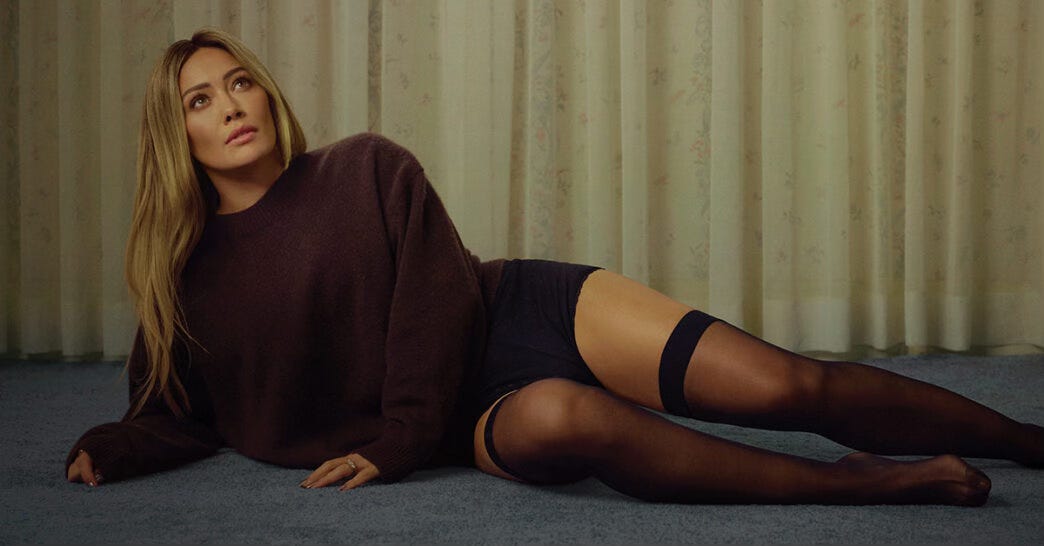
We call her Saint Hilary because canonisation is tidier than inquiry. To sanctify is to compress a complicated exchange into a usable story. Saints imply rescue. They allow gratitude to stand in for examination.
But sainthood, here, was never about salvation.
This essay goes live on February 20th, 2026 — the same day luck… or something is released. I am wary of building mythology out of shared dates. And yet the alignment feels apt. Duff returns with a record preoccupied with hindsight — revisiting the younger self, revising the narrative, reconsidering what once passed for inevitability as simply what was available at the time.
That recalibration is the engine of this ending, too.
On a warm afternoon in July 2024, I opened my laptop and wrote to the boy I had deceived. The house was quiet. I had Dignity playing — an album I once experienced as sleek defiance and now heard as something steadier, almost domestic in its self-possession. I did not expect the music to pull me backward. Most of my adolescence surfaces in memory as montage: break times, walks home, bootleg DVDs, CDs in plastic cases. But this was different. The recollection that rose was not charming or cinematic. It was precise: Fourteen. A borrowed name. A message sent in bad faith.
It is strange which versions of ourselves we want to rescue. I spent a decade drinking myself toward erasure, and yet it is the fourteen-year-old with the flip phone — hopeful, calculating, terrified of being known — who provokes the fiercest tenderness in me now.
I opened a blank document.
The letter was short. Plain. I named what I had done. I apologised. I did not describe the loneliness of being fourteen. I did not contextualise. I did not aestheticise. I did not mention animation, anonymity, or the how long it had taken me to understand the difference between caution and concealment. I did not try to make the story generous toward me.
I pressed send.
I had imagined that moment as something cinematic — the divided self stepping forward, the truth delivered into open air amidst a sudden downpour, some reciprocal gesture arriving to meet it. I had been trained, by stories, to expect that truth compels a counterpart.
Instead: nothing.
No anger. No absolution. No reply.
The silence was not charged this time. It did not vibrate with suspense. It simply existed.
Real life does not always offer a counterpart to your clarity. The other person is not required to complete your arc. There is no prince recognising the girl beneath the mask. No fabricated admirer revealed as destiny. Sometimes there is only the fact that you have said the thing plainly and must now live with the saying.
And yet something settled.
The point had never been forgiveness. The point was exposure — not the humiliating kind I had spent adolescence trying to outmanoeuvre, but the steadier act of standing in what I had done without rearranging it into something prettier. I had wanted to experience connection without risking visibility. This time I chose visibility without securing anything in return.
If sainthood means anything in this context, it is not that Hilary Duff rescued anyone, or that a single public correction in a PSA earned her a halo. It is that her work — songs that allowed feeling to move without exploding, films that depicted divided selves inching toward coherence — gave many of us a temporary structure. A place to practice holding contradictory parts without collapsing.
I mistook compartmentalisation for adulthood. The animated double. The arbitrated flirtation. The rationing of intensity. In truth, they were early survival skills, useful and incomplete.
Duff stood at the centre of a cultural moment that taught endurance more than liberation. It showed us how to function in the meantime — before language caught up, before representation widened, before we trusted our bodies to speak for themselves.
But sainthood also signals limitation. You kneel when you do not yet know how to stand.
Today marks, for her, a public insistence on adulthood — not youth resurrected, but age acknowledged. For me, it marks something quieter: the moment you make amends without securing applause; the moment you release a story from your control; the moment you stop confusing response with resolution.
I once believed intimacy could be earned by becoming abstract first.
Now I understand that presence is not a guarantee. It is a choice.
If there is any sainthood here, it is not hers alone. It belongs to the slow, unglamorous decision to stop mediating yourself in advance. To be legible without animation. To speak without disguise.
To accept that sometimes the only answer you receive is silence — and to remain anyway.
If you’ve read this far, thank you.
This essay began casually, almost as a joke. In October last year, I suggested to a friend that we hold a movie draft — “films so bad they’re good.” I knew immediately what my romantic comedy pick would be: A Cinderella Story. I also knew, just as quickly, that the choice wasn’t ironic.
When I tried to explain why, I found myself writing. At first it was just a few paragraphs about how Hilary Duff’s films had threaded themselves quietly through my life. Then the thread tightened. I started to trace how their meaning had changed — how what once felt like harmless nostalgia began to brush up against something unresolved.
In 2024, I had written a letter I assumed closed a chapter. An event no one else from that time likely remembers had remained lodged in me with disproportionate weight. Sobriety has a way of clarifying what you’d rather leave diffused. As the months passed, the clarity became harder to ignore. There is a particular discomfort in recognising yourself plainly — without narrative cushioning, without romance.
I was still carrying the story.
Writing this essay was not an attempt to redeem it or dramatise it. It was an attempt to understand it fully — to place it where it belonged rather than letting it distort quietly in the background. The further I have moved into sobriety, the less tolerable unfinished business has become. And when something becomes unbearable, I return to the one tool that has always steadied me.
I write it down.
Thank you for staying with me through it.
— G,
Oh Sweetie!
I think you and I are part of a very specific and rare population. Although, I believe you to be younger than I, we seem to embody a longing for connection that only the early 2000’s could have satiated.
When the Lizzie Mcguire movie came out I was already a couple of years into college and could sense a personal reinvention approaching. Most of my peers were already neck deep into addictions, living inside an elegy of their own senior year. These shortcomings would follow them well into the present, revealing a mediocrity they had to get used to. Some of them would resist and attempt to carry on their 17 year old ethos as I observed from afar sad and embarrassed for them. Most of my classmates slid into the expected: college, marriage, family, and career. It finally occurred to me that my high school experience appeared fairly traditional on the outside but was actually robbed from me by a manipulative much older boyfriend. Those early college days I was uncomfortable in my own skin after being freed from that relationship where so much of me was muted. Now I was making up for lost time that was my late teens. I gravitated toward the area of pop culture that was aimed at high schoolers such as Hillary Duff’s Metamorphosis and Britney Spear’s movie Crossroads.
By the time Cinderella story came out I had never entertained the idea of anonymity within internet interactions. Watching Hillary’s character exchange such saccharine messages spoke to the newly innocent and boy crazy side of me I was navigating. By 2004 and 2005 I had fine tuned my online persona into a mix of the lately unearthed real me and the vibes of Hillary Duff’s movies and music. The squeaky clean and cutesy Disney Channel mantras appealed to me because when I was that target demographic I operated on a scale of someone in their late 20’s enduring unspeakable acts. I’ve since grieved for that girl’s innocence I saw die in real time but have immense gratitude for the girl I finally cultivated.
At the end of 2005 I made the proverbial 20 something life change and moved to the big city (thankfully an hour away from my hometown). What that transition came with was my evolution into who I ultimately am till this day. Naturally my musical taste changed many times but no matter the elitism of the month I kept Hillary Duff in the cd binder.
It’s been so great finding someone like myself, thank you and your writing is what I relate to the most on SubStack.